Fast-charging networks are increasing both the number and the power rating of public charging points. The International Energy Agency’s Global EV Outlook 2026 reports that fast and ultra-fast chargers grew from 1.5 million in 2024 to 2.2 million in 2025, while next-generation chargers above 250 kW are becoming more common.
Higher charger power can shorten vehicle dwell time, but it also concentrates demand at service stations, fleet depots and logistics hubs. The transformer and medium-voltage connection often become critical-path items, especially where available substation capacity, site space or permitting is limited.
Charging Capacity Is Not the Same as Site Peak Demand
A site with ten 300 kW chargers does not necessarily need a transformer sized for a continuous 3 MW load, but it cannot be designed from charger count alone. Utilisation, simultaneous charging, vehicle type, arrival pattern, charging controls and future expansion all affect the maximum demand.
Managed charging can reduce peaks by allocating power across vehicles, while battery storage may provide short-duration support. The electrical design should still define a credible worst-case profile so that transformer temperature rise, voltage drop and protection coordination are based on agreed assumptions.
Transformer Requirements for High-Power Charging Sites
Load profile and diversity: provide expected charger utilisation, maximum simultaneous demand and any demand-management limits.
Future capacity: identify the ultimate number and rating of chargers so that space, cables and switchgear do not block expansion.
Power quality: review charger harmonic data, power factor, voltage fluctuation and the possible need for filters or derating.
Thermal conditions: consider high ambient temperature, enclosure ventilation, solar exposure and repeated rapid changes in loading.
Protection and grounding: coordinate transformer impedance, fault levels, neutral arrangement, surge protection and upstream switching.
Site constraints: confirm footprint, access, acoustic limits, fire separation and maintenance clearances before equipment selection.
Pad-Mounted or Dry-Type?
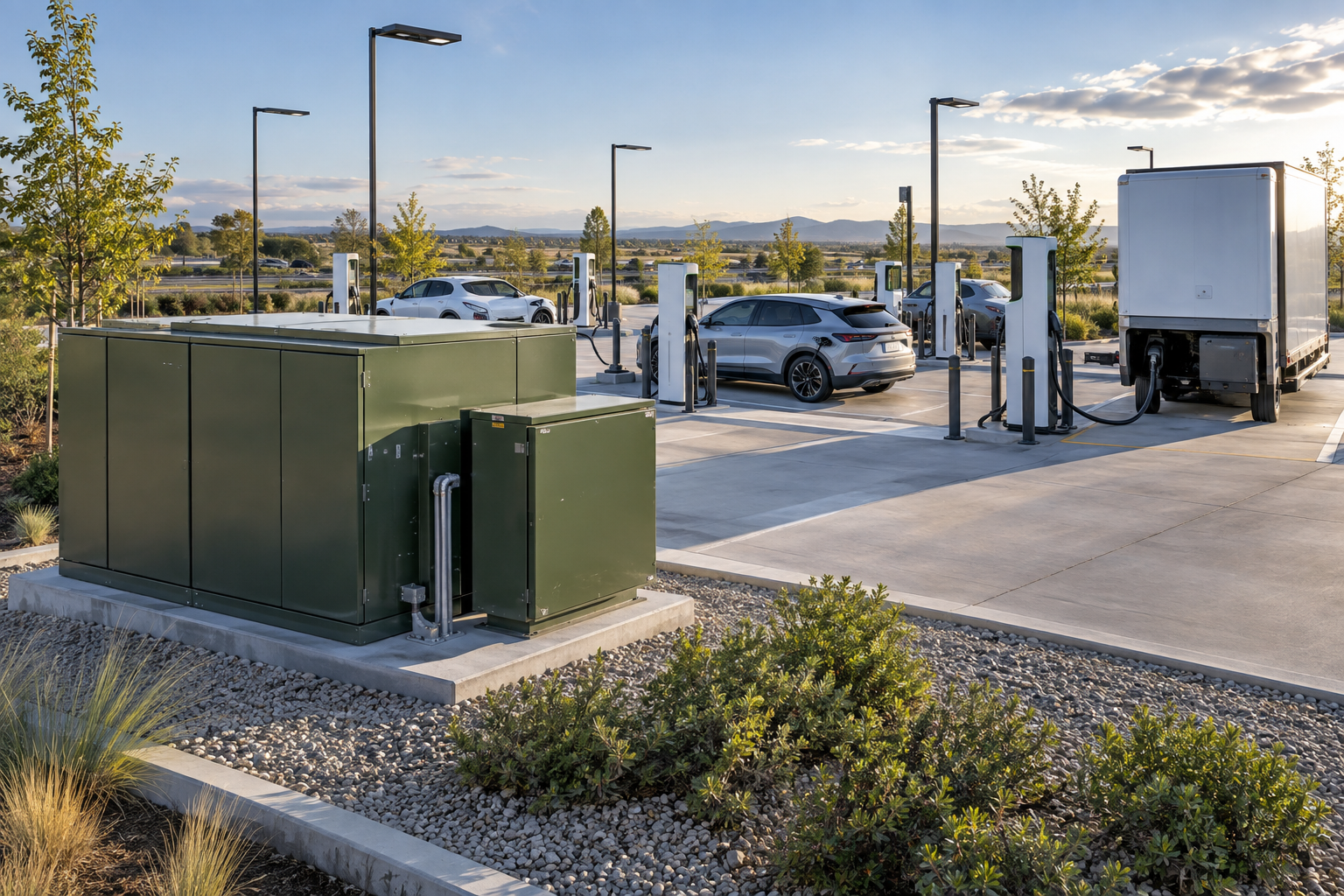
Outdoor public charging hubs commonly use pad-mounted transformers because the enclosed construction suits ground-level utility or customer-owned installations. Indoor parking structures or commercial facilities may prefer dry-type transformers where project codes, ventilation and fire-safety requirements support that choice.
The decision should not be made by location alone. Efficiency, losses, noise, maintenance, environmental conditions, utility requirements and total lifecycle cost need to be compared for the specific site.
Coordinate the Grid Connection Early
The IEA notes that limited substation capacity and network reinforcement can delay charging depots by several years. Developers should therefore begin the utility application, load study and equipment specification while the site layout is still flexible. Charger procurement, transformer manufacture and switchgear delivery should be managed as one programme.
So sánh các loại máy biến áp đặt trên bệ và máy biến áp đặt trên cột về các khía cạnh lắp đặt, an toàn, công suất, bảo trì và ứng dụng để lựa chọn giải pháp phân phối phù hợp.
Distribution-transformer efficiency, manufacturing capacity and material availability are again under review in the United States. In June 2026, the U.S. Department of Energy issued a request for information on how energy-conservation standards fo...
Trước khi lựa chọn thiết bị cho dự án của bạn, hãy so sánh các loại máy biến áp khô và máy biến áp ngâm dầu dựa trên các tiêu chí như hệ thống làm mát, lắp đặt, bảo trì, an toàn phòng cháy chữa cháy, hiệu suất và ứng dụng.
Utility-scale battery storage is expanding rapidly. The U.S. Energy Information Administration reported in August 2026 that operational battery storage capacity reached nearly 52 GW in the first half of the year after averaging 70% annual growth o...
 Các danh mục nổi bật











Gửi yêu cầu tư vấn về sản phẩm
Chúng tôi sẽ liên hệ với quý khách trong vòng 24 giờ